The preparation
The storyteller recounts a secretive ritual in which water is collected. Some explicit bodily details are part of the original spoken account.
A tale of coffee, longing and love magic, remembered in different voices and traced through print.
One version, passed on by word of mouth, places coffee at the heart of the ritual. Another, preserved in a video recording, calls it Saliguz or Slitak and describes the spell and its undoing. Published references also mention the name, though none establishes the ritual as historical fact.
Discover the tale ↓I · The account
In one recorded oral account associated with Eastern Serbia, Saliguz—also called Slitak—is described as a form of love magic thought to bind a man to a woman against his will.
The storyteller describes water gathered during an intimate ritual and secretly given to a man to drink. In the belief recounted, the man then becomes intensely fixated on the woman. These are details of a folk narrative, not claims that the magic works.
The same speaker goes on to describe how the enchantment might supposedly be lifted with the help of a beli mag (“white magician”). This part of the account features milk from a nursing mother, a cow that has recently calved, and the calf itself—a striking and unusual sequence in the speaker’s version of the tale.
“Sto sela, sto adeta.”II · The origins of the ritual
In this imagined prelude to the tale, a young woman is heartbroken and seeks advice from the elder women of her village. The collage follows her as she prepares for the ritual described in the remembered coffee variation.
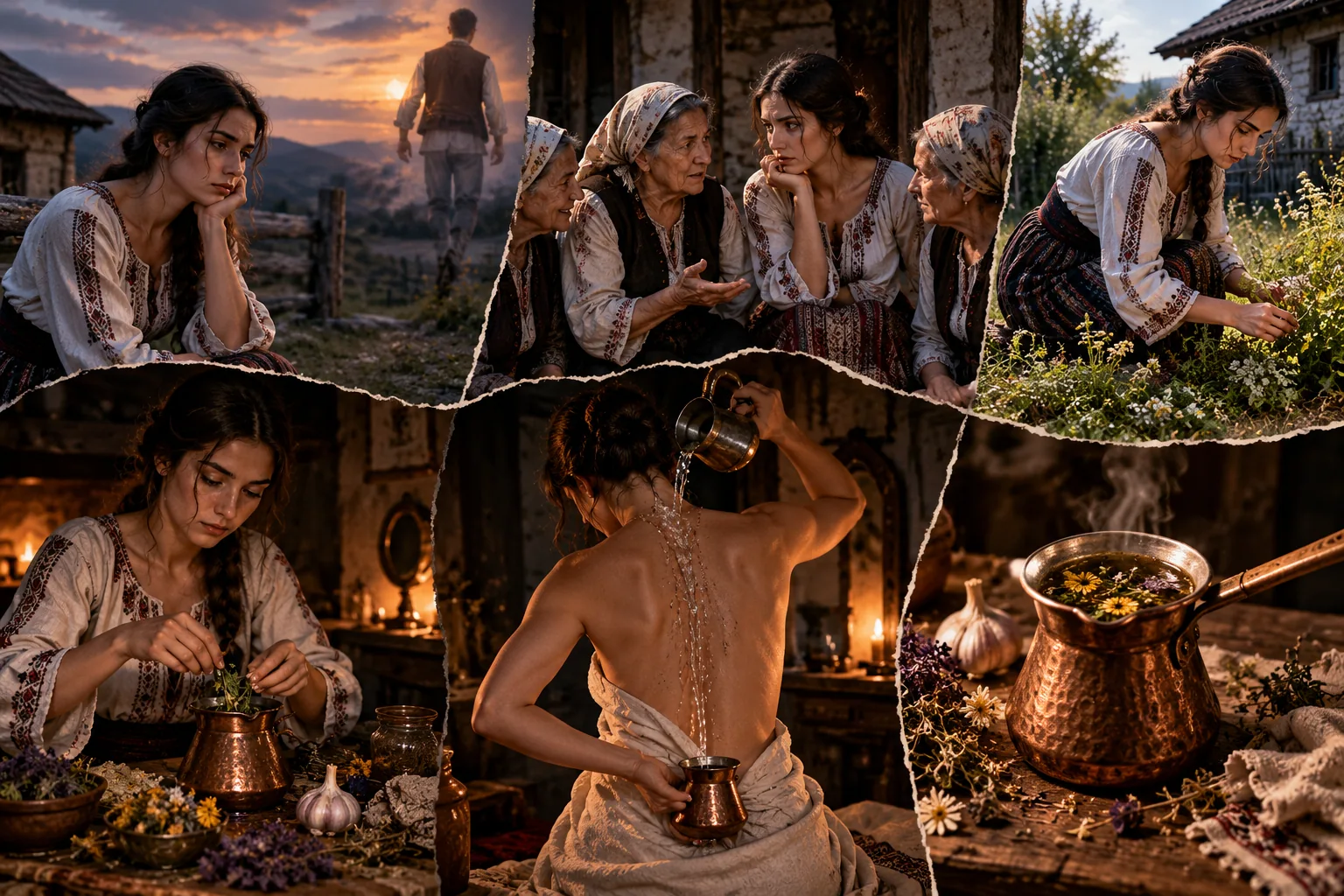
A fictionalized visual prelude inspired by the remembered variation, not a scene confirmed by the recorded speaker.
III · A remembered variation
In another version of Saliguz, recalled through oral storytelling, coffee is central to the act of love magic.
In this retelling, a woman pours water down her back, collects it in a vessel, and uses the gathered water to prepare coffee for the man whose affection she desires. The drink becomes the vehicle of the supposed enchantment: an everyday act of hospitality transformed into a secret act of intention.
This is a remembered variation, also closely resembling an anonymous B92 reader comment from 2020, rather than a detail established by the original video recording. It is included because oral traditions are not always told in precisely the same way—and because the coffee motif is an important part of the version passed on to this site's creator.
Beyond the tale · Coffee and music
The Saliguz story begins with coffee. Beyond the legend, a cup can become a ritual of its own: a moka pot simmering gently, a favourite record settling onto the platter, and a little time set aside to listen.
Explore the sound of a fine 1980s hi-fi setup, from Technics turntables and vintage amplifiers to Pink Floyd, Fleetwood Mac, Sade and a timeless jazz classic.
Coffee & Vinyl — Discover the listening room →IV · The narrative
The storyteller recounts a secretive ritual in which water is collected. Some explicit bodily details are part of the original spoken account.
The collected liquid is said to be given to the intended man. In the story, his thoughts become consumed by the woman.
A “white magician” is said to prescribe a remarkable ceremony involving milk, a newly calved cow and her calf to undo the supposed enchantment.
V · The oral account
“Sto sela, sto adeta.” — A hundred villages, a hundred customs.
In one recorded oral telling associated with Eastern Serbia, the speaker explains that the practice may be called Saliguz or Slitak, depending on the village. It is described as love magic believed to bind a man's attention and desire to a woman.
In this telling, a woman takes water associated with the dead, pours it down her back and collects the liquid after it passes over an intimate part of her body. She then gives the gathered liquid to the intended man to drink. According to the storyteller, he becomes entirely preoccupied with her and cannot return to his ordinary life.
The speaker then tells of a remedy sought from a beli mag — a “white magician.” His description involves milk obtained from a nursing mother and a ceremony with a recently calved cow and its calf. The man is said to undergo the rite until the calf has struck or nudged him several times, and his sweating is interpreted as a sign that the enchantment has passed.
These details are preserved here as elements of the speaker's account, not as a recommendation to perform the rite or as evidence of supernatural effects.
The recording does not explicitly say that coffee is prepared. A separate version remembered by this site's creator tells of the collected water being used to brew coffee, later served to the man. The two tellings share the motif of a drink associated with enchantment, but they are not identical.
According to an oral explanation of the name, Saliguz is linked to the idea of water being poured or flowing down the back and over the buttocks: a shortened, colloquial expression referring to the act itself. This is a folk explanation of the word, not a verified linguistic etymology.
Editor's note. This is a corrected English paraphrase of an automatically generated Serbian-language transcript, not a word-for-word translation. Some dialect expressions are unclear, so uncertain wording has been rendered conservatively. The additional story of the disappointed young woman guided by village elders, shown in the collage above, is an artistic dramatization rather than a detail established by the recording.
Folklore meets science · A field guide
Yesterday she was just a girl from the village. Today you cannot stop thinking about her. Was it Saliguz — or your own brain?
In the tale, Saliguz turns an ordinary encounter into an all-consuming romance. Here, being “Saliguzed” is a playful metaphor for the moment when someone you barely noticed suddenly becomes the centre of your thoughts. No magical explanation required.
You notice someone you hardly considered before; you replay conversations, check your phone and look forward to seeing her. An unexpected crush can feel like an enchantment, even when it is simply the wonderfully confusing nature of attraction.
Romantic attraction involves reward and motivation networks associated with dopamine. Excitement and stress may bring a racing heart, poor sleep or butterflies. Oxytocin and vasopressin participate in aspects of human bonding. There is no single chemical formula for love: these responses are part of a complex emotional and biological experience.
Pause before drawing conclusions. Ask whether affection is mutual, whether you feel respected and whether you are still sleeping, eating and living normally. You do not owe anyone a relationship because your feelings are intense.
The old Saliguz story offers a spectacular counter-ritual involving milk, a cow and her calf. Science offers no reason to think such a ritual removes romantic feelings.
If a crush is unwanted, give it room to settle without feeding it constantly: keep your routines, see friends, reduce repetitive checking of messages and social media, and make decisions according to your values rather than the intensity of the moment. Some feelings fade; others become calmer and more realistic over time.
There is no universal waiting period. If preoccupation, anxiety or low mood seriously affects your daily life, a mental-health professional can help you work through it.
Further reading: Harvard Medical School — The Science of Love · Neuroimaging meta-analysis of love.
VI · Written traces and source timeline
The name Saliguz is not confined to a single recollection. A literary reference appears in 2015, while news coverage and a reader's detailed account appeared in October 2020. These dated sources establish that the name and related motifs were in circulation, but do not establish the age, geographical origin or actual performance of the alleged ritual.
Svetislav Basara's satirical novel Anđeo atentata (Laguna, 2015) refers to Saliguz being added to coffee, with a footnote describing a different supposed love-potion formulation involving water and menstrual blood. This is fictional satire, not an ethnographic account. The mention appears on printed page 17 of the publisher's excerpt.
Read the published excerpt (PDF)
A RINA-sourced report published by Telegraf describes the name Saliguz in a story about magical beliefs in Pranjani near Gornji Milanovac, western Serbia. Other outlets republished closely related reporting. These are not separate, independent field studies.
Read the Telegraf report, 15 October 2020
Under a B92 article about these beliefs, a reader posting as Kursula described a girl going to a crossroads at the full moon, pouring water down her back, collecting it and using it to brew coffee for a desired man. This closely resembles the remembered coffee version featured on this site. The comment is anonymous and unverified, and cannot establish an independent tradition by itself.
Read the B92 discussion (comment by “Kursula”)
Two publicly shared videos are relevant starting points for further study: one containing the story of Saliguz or Slitak and its supposed undoing, and a second described as a radio discussion of Saliguz. This page does not treat the second video's content as transcribed or verified.
Oral recording · Radio discussion
Source note. These items serve different purposes: a novel demonstrates literary usage, a news report records a reported local belief, a reader comment recounts an anonymous variant, and recordings preserve individual voices. None proves that love magic works, nor do these mentions establish a unique regional origin.
VII · Visual interpretation
These illustrations are contemporary artistic interpretations inspired by the tale. They should not be mistaken for historical photographs or exact reconstructions of the oral account.
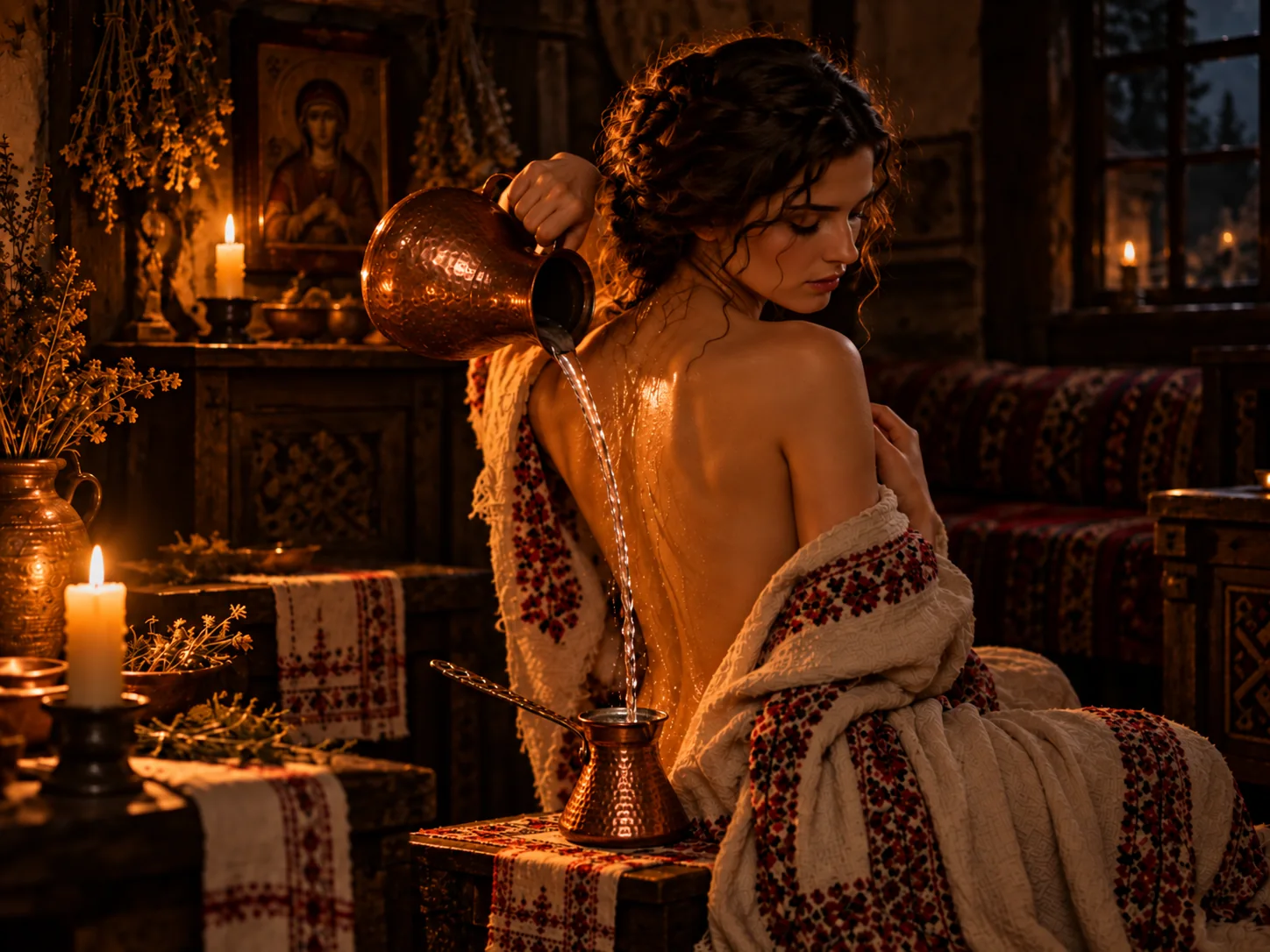
An imagined ritual scene. The source does not independently establish the depicted setting or appearance.
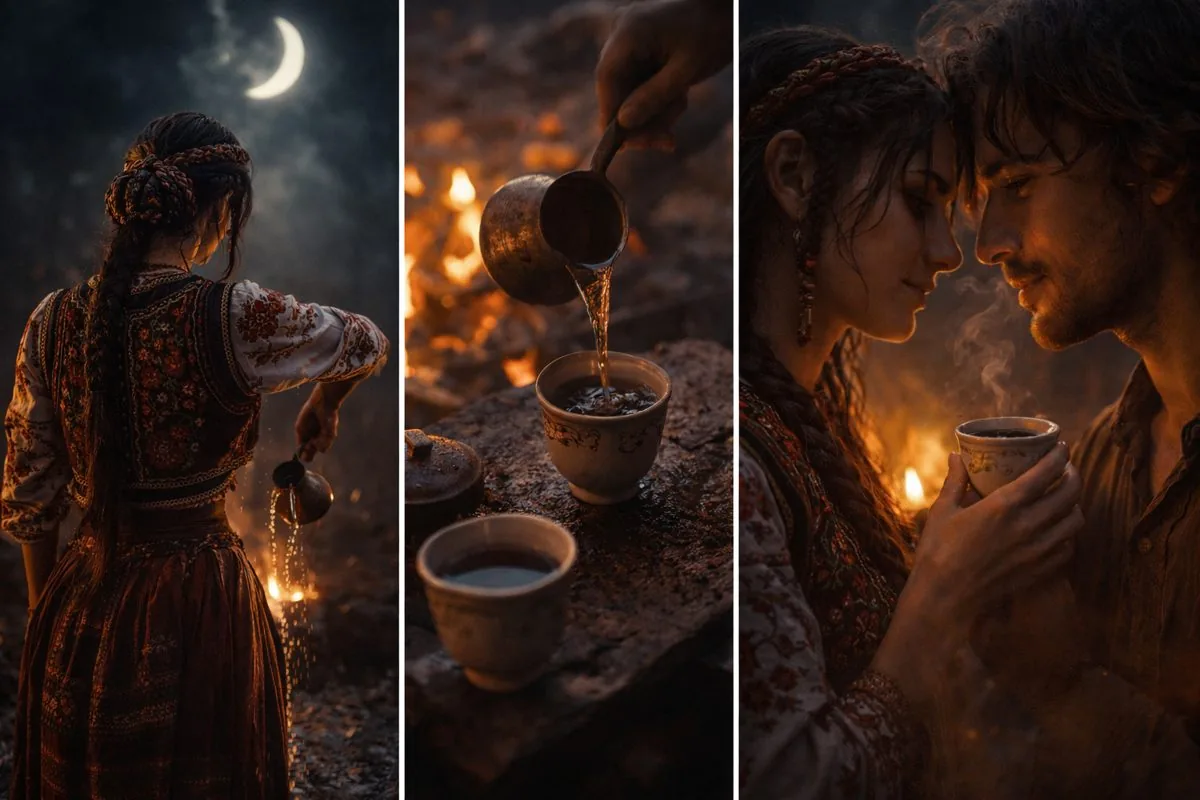
The Saliguz Triptych. Preparation, brewing and offering as an artistic sequence. The coffee-brewing scene reflects the separately remembered coffee version. The recorded speaker describes giving the collected liquid to drink, but does not explicitly mention preparing coffee.
VIII · Reimagined scenes
The following newly created images interpret motifs from the recorded oral account and the separately remembered coffee variation. They illustrate key moments associated with the tale: the remembered water-and-coffee variation, the offering of the drink, and the unusual counter-ritual involving milk, a cow, and her calf.
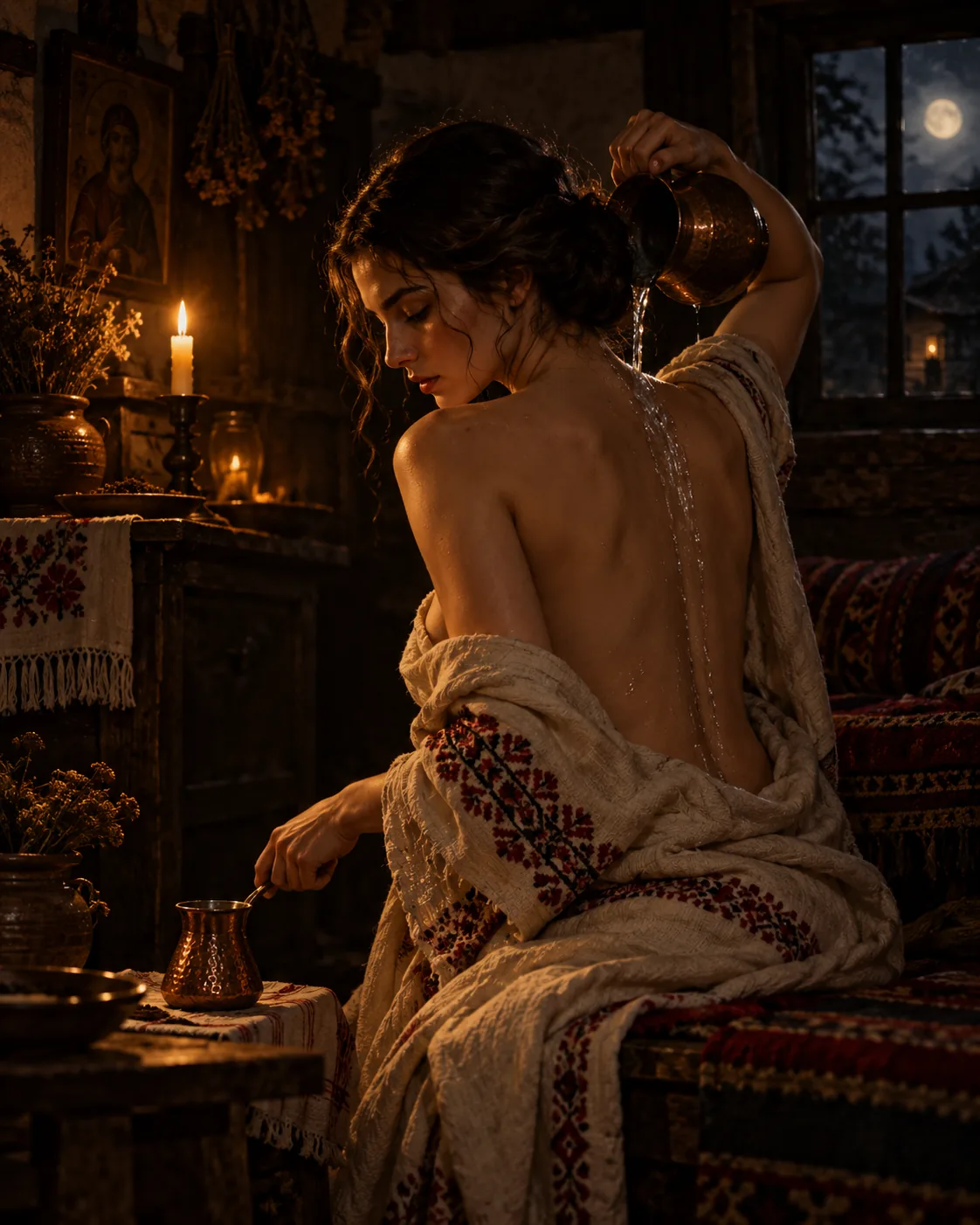
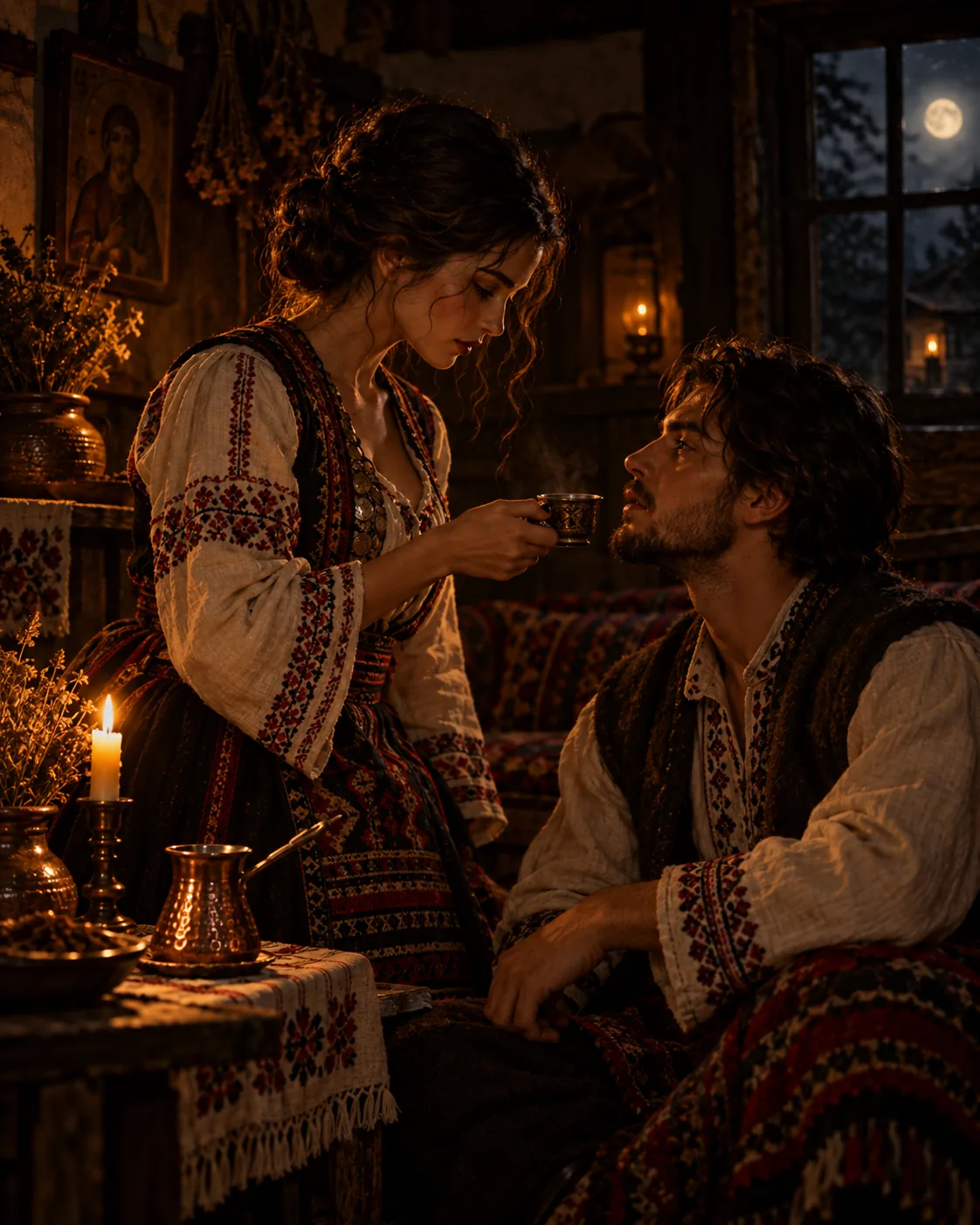
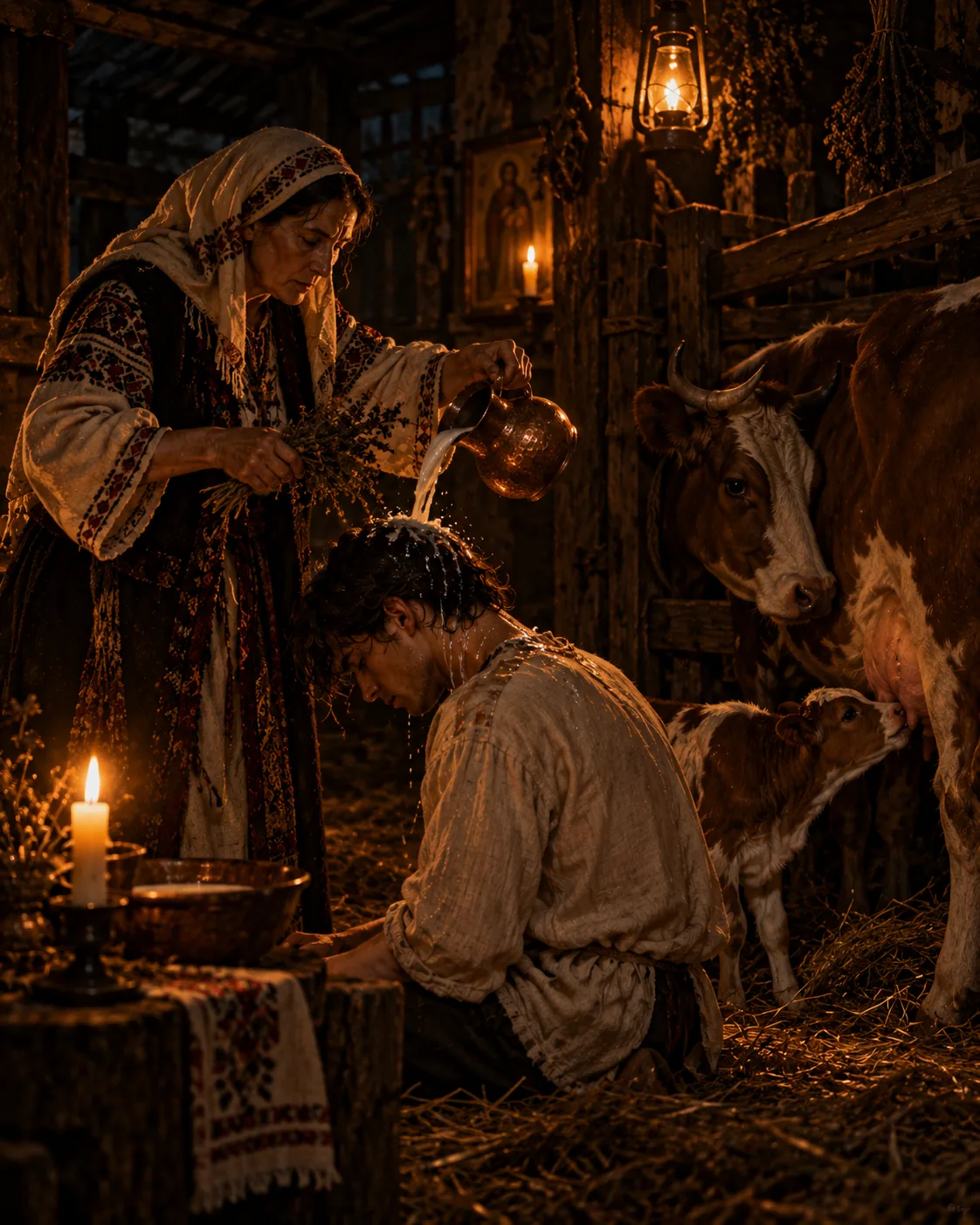
Interpretive note: These scenes are modern visual interpretations based on oral storytelling and a transcript of the recorded account. They are not historical documentation or literal proof of real ritual practice.
A note on anatomy: Yes, some arms and hands may look unusually gifted. Let us simply say that the people portrayed here possess certain specific anatomical qualities that make the practice of Saliguz far easier than it would be for ordinary mortals.
Know a regional variation, an old recording, or a forgotten folk tale? We'd love to hear from you.