Inspect the brewer
Make sure the safety valve is clear and the gasket and filter are clean and seated correctly.
Coffee culture · Italian design
A small aluminum icon that brought rich, concentrated coffee into the home.
Discover its invention, the science inside its three chambers, and the simple rituals of making a better cup.
Explore the story ↓I · Origins
The iconic Moka Express dates to 1933 and is credited to Italian inventor and entrepreneur Alfonso Bialetti.
Alfonso had established an aluminum-working business in Crusinallo, Italy. He developed a compact stovetop brewer with a recognisable eight-sided body, helping bring a café-like strong coffee experience into ordinary kitchens.
Some historical accounts also name Luigi De Ponti in the early invention and patent story. After the Second World War, Alfonso’s son Renato Bialetti expanded production and advertising, turning the Moka Express into a widely recognised household object.
By 1953 the famous mustachioed little man had become part of the brand’s identity. The moka pot later earned recognition as a landmark of industrial design, including a place in the collection of New York’s Museum of Modern Art.
II · The engineering
There are three main parts: a bottom chamber holding water, a metal funnel holding ground coffee, and a top chamber where the finished drink collects. As the lower chamber heats, pressure pushes hot water upward through the coffee bed and into the top.
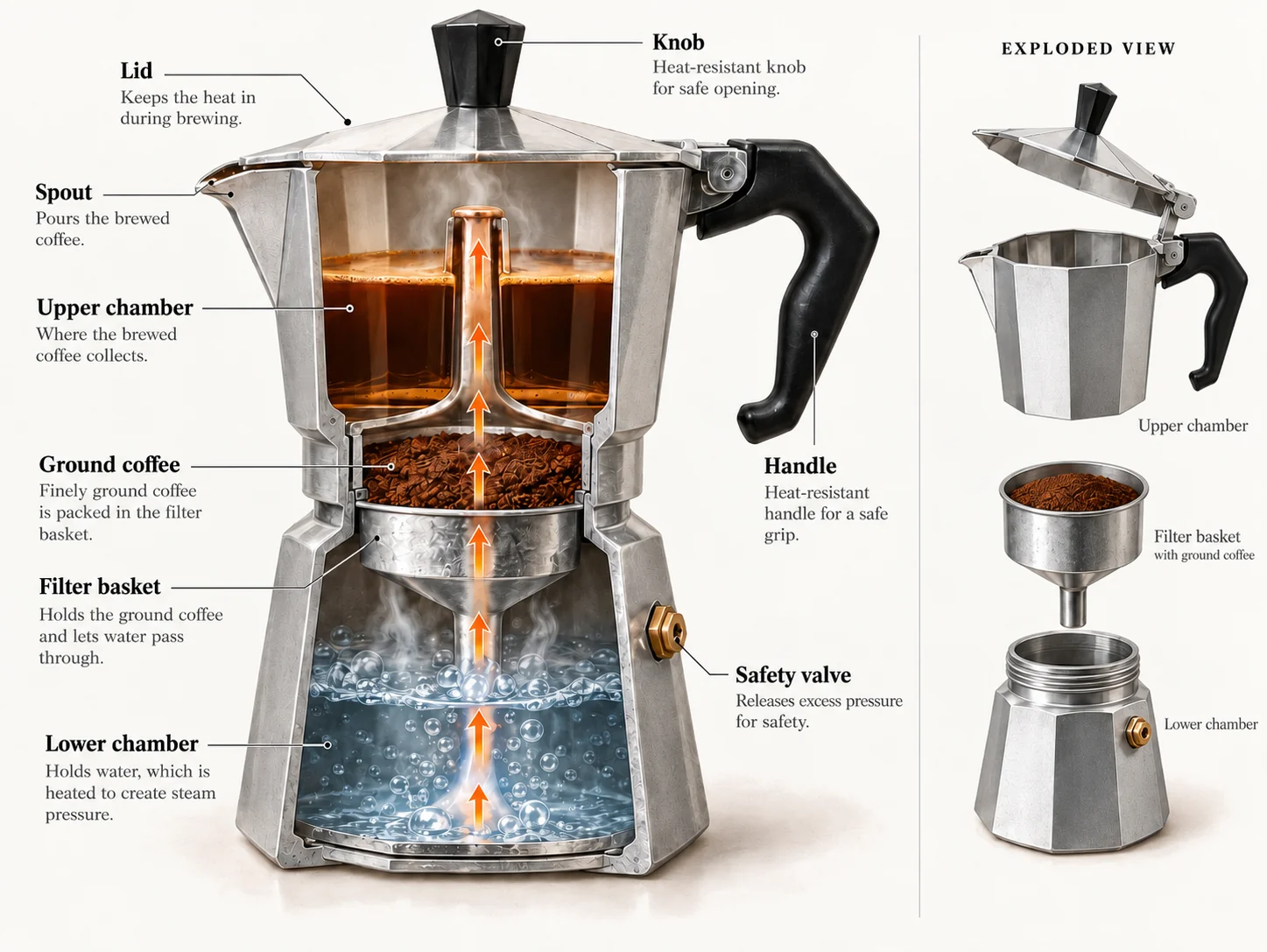
A moka pot produces concentrated, full-bodied coffee, but it is not the same as machine-made espresso: the brewing pressures and resulting texture differ.
III · Practical guide
Use a clean moka pot, fresh medium-fine ground coffee and gentle heat. Always follow the safety instructions for your particular model.
Make sure the safety valve is clear and the gasket and filter are clean and seated correctly.
Add fresh water to just below the safety valve. Never cover or block the valve. Hot water can shorten brewing time, but use a towel when assembling a heated base.
Use a grind finer than most drip-filter coffee, but generally coarser than espresso. Adjust to taste and your grinder.
Fill the funnel evenly, level the surface, and never tamp the grounds. Remove stray grounds from the rim before assembling.
Assemble securely, place over gentle heat, and keep the handle away from the flame. Use the heat setting recommended for your model.
When the flow starts sputtering or gurgling, remove the pot from the heat promptly to avoid an overly bitter finish.
Carefully mix the finished coffee in the upper chamber with a spoon, then serve immediately. Allow the pot to cool before opening or cleaning.
Bitter coffee? Try less heat, a slightly coarser grind, and removing the pot earlier.
Weak coffee? Check grind freshness and whether the basket is filled evenly, without tamping.
Steam leaking sideways? Stop, cool the pot, then check the gasket, threads and basket seating before trying again.
Do not operate a moka pot with a blocked safety valve, damaged gasket, or overfilled water chamber. Never open it while hot and pressurised.
IV · A different coffee tradition
The džezva traditionally prepares finely ground coffee directly in water in an open vessel. A moka pot instead uses heat-generated pressure to send water through grounds in a filter basket. Both have strong cultural associations, but they are different brewing devices.
The Saliguz legend describes a džezva in one remembered version, not an Italian moka pot. This page is a separate exploration of coffee history, not a claim that the moka pot belonged to the old folk ritual.
Return to the Saliguz tale →Beyond the cup · Slow listening
While the moka pot brews over gentle heat, there is time to choose a record. Coffee and vinyl reward attention: not because they demand nostalgia, but because each asks us to slow down and enjoy the experience.
Enter the Coffee & Vinyl room →V · Further reading
Know a regional variation, an old recording, or a forgotten folk tale? We'd love to hear from you.